Overview of 50+ System Functions
HAP provides over 50 built-in functions across five categories: Math, Date, Text, Logical, and Advanced. These functions cover most common data processing scenarios and can be used in formula fields, default values, and workflow calculations.
Math Functions
SUM
Description: Returns the sum of multiple values
Syntax: SUM(value1, value2, value3, ...)
Example: SUM(3, 6, 8) → 17
Empty values are treated as 0.
AVERAGE
Description: Returns the average of multiple values
Syntax: AVERAGE(value1, value2, value3, ...)
Example: AVERAGE(3, 6, 8) → 5.67
Handling empty and zero values:
-
Empty values: Ignored in calculation
Example: (2 + 4) / 2 = 3 -
Zero values: Included in calculation
Example: (0 + 2 + 4) / 3 = 2
MIN
Description: Returns the smallest value
Syntax: MIN(value1, value2, value3, ...)
Example: MIN(3, 6, 8) → 3
Empty values are treated as 0.
MAX
Description: Returns the largest value
Syntax: MAX(value1, value2, value3, ...)
Example: MAX(3, 6, 8) → 8
Empty values are treated as 0.
PRODUCT
Description: Returns the product of multiple values
Syntax: PRODUCT(value1, value2, value3, ...)`
Example: PRODUCT(3, 6, 8) → 144
Empty values are treated as 0.
COUNTA
Description: Counts the number of non-empty fields
Syntax: COUNTA(field1, field2, field3 ...)
Example:
Returns 2 if two fields contain values
ABS
Description: Returns the absolute value of a number
Syntax: ABS(value)
Example: ABS(-3.991) → 3.991
INT
Description: Returns the largest integer less than or equal to the value
Syntax: INT(value)
Example:
- INT(3.991) → 3
- INT(-3.991) → -4
MOD
Description: Returns the remainder of a division
Syntax: MOD(dividend, divisor)
Notes:
- Both parameters are required
- Empty dividend → treated as 0
- Empty or zero divisor → calculation is skipped
ROUND / ROUNDUP / ROUNDDOWN
ROUND
Description: Rounds a number to a specified number of decimal places
Syntax: ROUND(value, digits)
Example: ROUND(3.14159, 3) → 3.142
ROUNDUP
Description: Rounds a number away from zero
Syntax: ROUNDUP(value, digits)
Example: ROUNDUP(3.14159, 3) → 3.142
ROUNDDOWN
Description: Rounds a number toward zero
Syntax: ROUNDDOWN(value, digits)
Example: ROUNDDOWN(3.14159, 3) → 3.141
Notes:
- Ensure the number of decimal places matches the field configuration
- If
digitsis omitted, the result defaults to an integer
CEILING / FLOOR
CEILING
Description: Rounds a number up to the nearest multiple
Syntax: CEILING(value, significance)
Example: CEILING(9, 2) → 10
FLOOR
Description: Rounds a number down to the nearest multiple
Syntax: FLOOR(value, significance)
Example: FLOOR(9, 2) → 8
POWER
Description: Returns a number raised to a power
Syntax: POWER(base, exponent)
Example: POWER(4, 3) → 64
LOG
Description: Returns the logarithm of a number
Syntax: LOG(number, base)
Example: LOG(9, 3) → 2
COUNTBLANK
Description: Counts the number of empty values
Syntax: COUNTBLANK(value1, value2, value3, ...)`
Example: Returns 2 if two values are empty
COUNTCHAR
Description: Returns the number of characters in a text field
Syntax: COUNTCHAR(text)
RANDBETWEEN
Description: Returns a random integer between two values (inclusive)
Syntax: RANDBETWEEN(min, max)
NUMBER
Description: Converts text or other data types into a numeric value
Syntax: NUMBER(text)
PI
Description: Returns an approximation of the mathematical constant π (the ratio of a circle’s circumference to its diameter). This function does not require any parameters.
Syntax: PI()
Example: Retrieve the value of π
PI()
- Result: Returns 3.141592653589793
RADIANS
Description: Converts an angle from degrees to radians. Trigonometric functions (such as SIN, COS, and TAN) require radians as input, so this function is typically used for conversion before calculation.
Syntax: RADIANS(degrees)
Example: Convert degrees to radians
Convert 90 degrees to radians:
RADIANS(90)
- Result: Returns 1.5707963267949 (90° ≈ 1.5708 radians)
DEGREES
Description: Converts an angle from radians to degrees. This is the inverse of the RADIANS function and is commonly used to convert calculation results into degrees.
Syntax: DEGREES(radians)
Example: Convert radians to degrees
Convert π radians to degrees:
DEGREES(PI())
- Result: Returns 180 (π radians = 180°)
SIN
Description: Returns the sine of an angle specified in radians.
Note: The input must be in radians. If using degrees, convert them with RADIANS first.
Syntax: SIN(radians)
Example: Calculate sine value
SIN(1)
- Result: Returns 0.841470984807897
Tip: Calculate using degrees
SIN(RADIANS(30)) → 0.5
COS
Description: Returns the cosine of an angle specified in radians.
Note: The input must be in radians. If using degrees, convert them with RADIANS first.
Syntax: COS(radians)
Example:
COS(1)
- Result: Returns 0.54030230586814
TAN
Description: Returns the tangent of an angle specified in radians.
Note: The input must be in radians. If using degrees, convert them with RADIANS first.
Syntax: TAN(radians)
Example:
TAN(1)
- Result: Returns 1.5574077246549
ASIN
Description: Returns the arcsine (inverse sine) of a value. The result is returned in radians. Use DEGREES to convert it to degrees if needed.
Syntax: ASIN(number)
(The input must be between -1 and 1)
Example:
ASIN(0.84114709848079)
- Result: Returns approximately 0.999400825621613
ACOS
Description: Returns the arccosine (inverse cosine) of a value. The result is returned in radians. Use DEGREES to convert it to degrees if needed.
Syntax: ACOS(number)
(The input must be between -1 and 1)
Example:
ACOS(0.54030230586814)
- Result: Returns 1
ATAN
Description: Returns the arctangent (inverse tangent) of a value. The result is returned in radians. Use DEGREES to convert it to degrees if needed.
Syntax: ATAN(number)
Example:
ATAN(1)
- Result: Returns 0.785398163397448 (≈ 45°)
NORM_S_DIST
Description: Returns the standard normal distribution (mean = 0, standard deviation = 1).
Syntax: NORM_S_DIST(z, [cumulative])
Parameters:
- z: The value for which you want the distribution
- cumulative: Logical value that determines the return type
true(default): Returns cumulative distributionfalse: Returns probability density function
Example:
NORM_S_DIST(1.96, true)
- Result: Returns 0.975 (indicating a 97.5% cumulative probability)
PERMUT
Description: Returns the number of permutations for a given number of objects (order matters).
Syntax: PERMUT(total_number, number_chosen)
Parameters:
- total_number: Total number of items (non-negative integer)
- number_chosen: Number of items selected (non-negative integer)
Example:
Select and arrange 3 items from 5:
PERMUT(5, 3)
- Result: Returns 60
COMBIN
Description: Returns the number of combinations for a given number of objects (order does not matter).
Syntax: COMBIN(total_number, number_chosen)
Parameters:
- total_number: Total number of items (non-negative integer)
- number_chosen: Number of items selected (non-negative integer)
Example:
Select 3 items from 5 (order does not matter):
COMBIN(5, 3)
- Result: Returns 10
Date Functions
NETWORKDAY
Description: Calculates the number of working days between two dates. Weekends (Saturday and Sunday) are excluded by default. You can also specify additional holidays to exclude.
The function returns a numeric value and can be used in number, currency, and text fields.
Parameters:
- Start date and end date are required
- Holidays (optional): Specify dates to exclude using
[]. If not provided, only weekends are excluded
Counting logic:
Includes dates greater than or equal to the start date and less than or equal to the end date.
For example, [5th, 7th] includes the 5th, 6th, and 7th → total 3 days.
Syntax:
NETWORKDAY(start_date, end_date, [holiday1, holiday2, ...])
Example 1: Exclude weekends only
Configuration
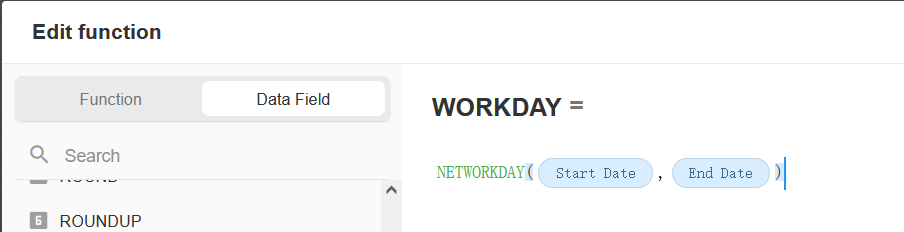
NETWORKDAY('2024-3-1','2024-3-4')
March 2 and 3 are weekends, so only March 1 and 4 are counted → 2 days
Example 2: Exclude weekends and specific holidays
Configuration
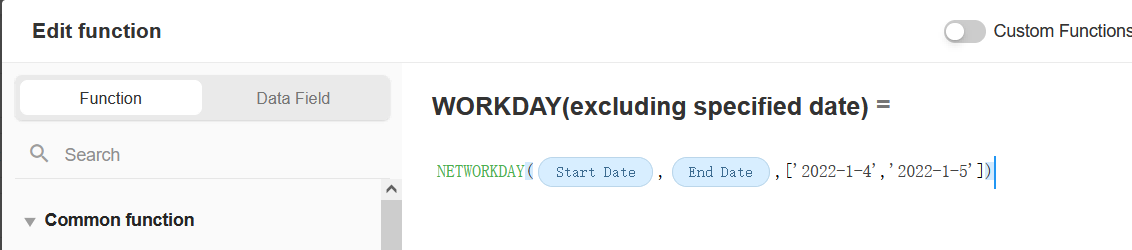
NETWORKDAY('2024-3-1','2024-3-6',['2024-3-4','2024-3-5'])
Excludes weekends (2nd–3rd) and specified holidays (4th–5th), leaving only March 1 and 6 → 2 days
MINUTE / HOUR
Description: Returns the minute or hour from a datetime value
Syntax:
- HOUR(
datetime) → returns 0–23 - MINUTE(
datetime) → returns 0–59

WEEKDAY
Description: Returns the day of the week as a number (1–7), where Monday = 1 and Sunday = 7
Syntax:
WEEKDAY(datetime)

DAY / MONTH / YEAR
Description: Extracts the day, month, or year from a date
Syntax:
- DAY(
date) → returns 1–31 - MONTH(
date) → returns 1–12 - YEAR(
date) → returns the year (e.g., 2022)
Configuration:
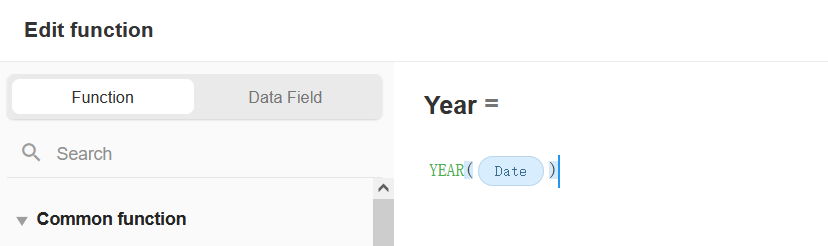
Result:

DATENOW
Description: Returns the current date and time. Can be used in datetime and text fields.
Syntax: DATENOW()
Configuration
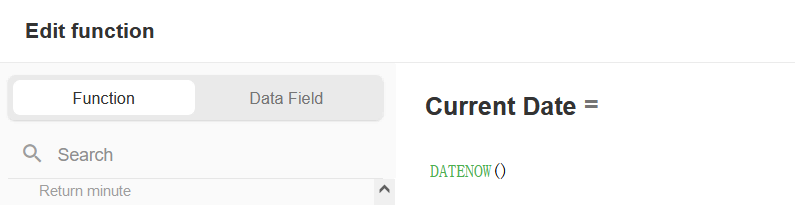
Result

DATEADD
Description: Adds or subtracts a time interval from a date and returns a new date/time
Syntax:
DATEADD(date, 'offset', format)
Parameters:
-
offset: Text value in the format:
(+/-)(number)(unit) Units:'Y'= year'M'= month'd'= day'h'= hour'm'= minute
Examples:
'-1d'→ subtract 1 day'+3m'→ add 3 minutes'+3M'→ add 3 months
-
format:
1= date only2= date + time
Example 1: Calculate probation end date (3 months later)
DATEADD('2021-3-6','+3M',1) → 2021-6-6
Example 2: Add 1 hour to a timestamp
DATEADD('2021-3-6 9:00','+1h',2) → 2021-3-6 10:00
More examples:
-
Start of current week (Monday):
DATEADD(DATENOW(), CONCAT('-', WEEKDAY(DATENOW())-1, 'd'), 1) -
End of current week (Sunday):
DATEADD(DATENOW(), CONCAT('+', 7-WEEKDAY(DATENOW()), 'd'), 1)
If the offset is dynamic, use CONCAT() to construct it.
DATEIF
Description: Calculates the time difference between two dates.
The result includes a unit and is returned as text.
Syntax:
DATEIF(start_date, end_date, format, 'unit')
Parameters:
-
start_date / end_date: Required
-
format (required): Specify
1or2.
If the date field includes a time value, the actual timestamp is used.
If not, the system applies the selected format:-
format 1:
Both start and end dates are calculated from00:00 -
format 2:
Start date is calculated from00:00, and end date from24:00
-
-
unit (optional):
'Y'= years'M'= months'd'= days (default)'h'= hours'm'= minutes
Examples:
- DATEIF('2021-12-1','2021-12-2',1,'d') → 1 day
- DATEIF('2021-12-1','2021-12-2',2,'d') → 2 days
- DATEIF('2021-12-1','2021-12-2 12:00',2,'d') → 1 day (rounded down)
Configuration and result:
-
Format 1
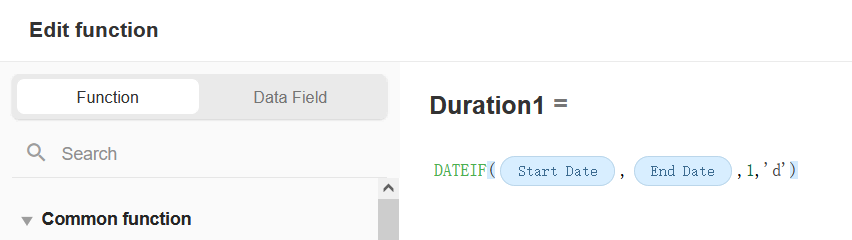
-
Format 2
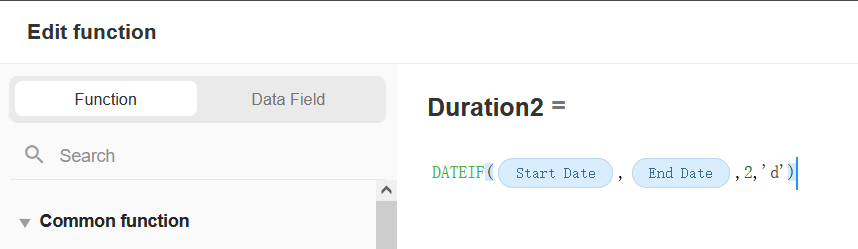
-
Result
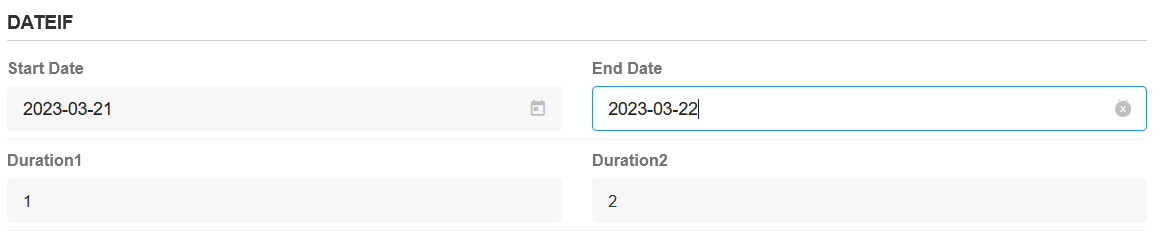
Using DATEIF Results in Further Calculations
Since DATEIF returns text (for example, "6 days"), you need to convert it to a number before performing further calculations.
Example:
To calculate "6 days" + 5 → 11 days
NUMBER(FIND(DATEIF('2021-3-8','2021-3-14',2,'d'), "", "days")) + 5
Steps:
- Use FIND to remove the unit text
- Use NUMBER to convert the result to a numeric value
- Perform the calculation
WEEKNUM
Description: Returns the week number of a given date within a year (i.e., the week in which the date falls).
Syntax: WEEKNUM(date, [return_type])
Parameters:
- date (required): A valid date value
- [return_type] (optional): Defines how weeks are calculated. Default is
1- 1: Week starts on Sunday (Sunday is treated as the first day of the week)
- 2: Week starts on Monday (Monday is treated as the first day of the week)
Example:
- Formula: WEEKNUM('2025-02-19', 2)
- Result: 8
- Notes: February 19, 2025 falls in the 8th week of the year when weeks start on Monday.
WORKDAY
Description: Calculates a date a specified number of working days before or after a start date. Weekends (Saturday and Sunday by default) and optional holidays are excluded automatically.
Syntax: WORKDAY(start_date, days, [holidays])
Parameters:
- start_date (required): The start date for calculation
- days (required): Number of working days to offset
- Positive values: future dates
- Negative values: past dates
- [holidays] (optional): A list or array of dates to exclude as holidays
Example:
- Formula: WORKDAY('2025-02-19', 10, ['2025-02-23', '2025-02-28'])
- Result: 2025-03-06
- Explanation: Calculates 10 working days after February 19, 2025, excluding weekends and the specified holidays.
WORKDAY_INTL
Description: An extended version of WORKDAY. It allows you to define custom weekend rules, making it suitable for different regions, industries, or scheduling systems.
Syntax: WORKDAY_INTL(start_date, days, [weekend], [holidays])
Parameters:
- start_date (required): A valid date
- days (required): Number of working days to offset
- Positive values: forward calculation
- Negative values: backward calculation
- [weekend] (optional): Defines which days are treated as weekends
- Uses codes from 1 to 17
- Default is 1 (Saturday and Sunday)
- [holidays] (optional): A list or array of holiday dates to exclude
Common weekend codes:
| Code | Weekend Days | Description |
|---|---|---|
| 1 | Saturday, Sunday (default) | Standard weekend |
| 2 | Sunday, Monday | Two-day weekend |
| 3 | Monday, Tuesday | Two-day weekend |
| 4 | Tuesday, Wednesday | Two-day weekend |
| 5 | Wednesday, Thursday | Two-day weekend |
| 6 | Thursday, Friday | Two-day weekend |
| 7 | Friday, Saturday | Two-day weekend |
| 11 | Sunday only | Single-day weekend |
| 12 | Monday only | Single-day weekend |
| 13 | Tuesday only | Single-day weekend |
| 14 | Wednesday only | Single-day weekend |
| 15 | Thursday only | Single-day weekend |
| 16 | Friday only | Single-day weekend |
| 17 | Saturday only | Single-day weekend |
Example:
WORKDAY_INTL("2026-06-01", 6, 11, ["2026-06-03","2026-06-04"])
Explanation:
- Start date: 2026-06-01
- Working days to calculate: 6
- Weekend rule: Sunday only (code
11) - Additional holidays: 2026-06-03 and 2026-06-04
Result: 2026-06-10
How to dynamically maintain holiday lists
If holidays are stored in a text field (e.g., Holiday List), you do not need brackets ([]) when entering values. Simply separate dates using commas.
-
Text field example:
2026-06-07,2026-06-08 -
Usage in formulas:
UseSPLIT()to dynamically convert the text into an array for functions such asNETWORKDAY,WORKDAY, orWORKDAY_INTL.
Example:
WORKDAY(start_date, 5, SPLIT(Holiday List, ","))
Text Functions
CONCAT
Description: Combines multiple values into a single text string.
Syntax: CONCAT(value1, value2, ...)
Example:
CONCAT(Sales, '-', Kevin Jones)
You can combine field values with static text. For example, concatenate a department field and a name field using a separator (-).
Result: Sales-Kevin Jones
REPLACE
Description: Replaces part of a text string with another value.
Syntax: REPLACE(text, start_position, length, new_text)
Parameters:
- start_position: Starting position (1-based index).
- length: Number of characters to replace.
Example:
REPLACE('4155552671', 4, 3, '***')
Masks part of a phone number.
Result: 415***2671
MID
Description: Extracts a substring from the middle of a text string.
Syntax: MID(text, start_position, length)
Parameters:
- text (required)
- start_position (required)
- length (required)
Example:
MID('ORD-2025-000123', 5, 4)
Extracts the year from an order number.
Result: 2025
RIGHT
Description: Extracts characters from the right side of a text string.
Syntax: RIGHT(text, length)
Example:
RIGHT('ORD-2025-000123', 6)
Result: 000123
LEFT
Description: Extracts characters from the left side of a text string.
Syntax: LEFT(text, length)
Example:
LEFT('ORD-2025-000123', 3)
Result: ORD
TRIM
Description: Removes leading and trailing spaces from text.
Syntax: TRIM(text)
CLEAN
Description: Removes all spaces from a text string.
Syntax: CLEAN(text)
REPT
Description: Repeats a text value a specified number of times.
Syntax: REPT(text, number_of_times)
Example:
REPT('*', 5)
Result: *****
LOWER
Description: Converts all letters in a text string to lowercase.
Syntax: LOWER(text)
Example:
LOWER('JohnDOE')
Result: johndoe
UPPER
Description: Converts all letters in a text string to uppercase.
Syntax: UPPER(text)
Example:
UPPER('JohnDoe')
Result: JOHNDOE
STRING
Description: Converts a value to text format.
Syntax: STRING(value)
Example:
- STRING(1 + 5) →
6 - STRING(1) + STRING(5) →
15
FIND
Description: Extracts a substring using start and end delimiters.
Syntax: FIND(text, start_delimiter, end_delimiter)
The delimiters are not included in the result.
Example:
If a field contains: 200*15
-
Extract the first value:
FIND('20015', '', '') -
Extract the second value:
FIND('20015', '', '')
FINDA
Description: Extracts multiple substrings and returns them as an array.
Syntax: FINDA(text, delimiter_start, delimiter_end)
Example:
FINDA("(A)(B)(C)", "(", ")")
Result: A,B,C
SPLIT
Description: Splits text into an array using a delimiter.
Syntax: SPLIT(text, "delimiter")
Example:
SPLIT('California/Los Angeles/Westwood', '/')
Result: California,Los Angeles,Westwood
JOIN
Description: Joins array elements into a single string using a delimiter.
Syntax: JOIN(array, "delimiter")
Example:
JOIN(Assignees, '-')
Result: John Doe-Jane Smith-Mike Lee
SUBSTITUTE
Description: Replaces occurrences of a substring within a text string.
Syntax: SUBSTITUTE(text, old_text, new_text, [instance_num])
Example 1: Replace a specific occurrence
SUBSTITUTE("Apple-Apple-Apple", "Apple", "Banana", 2)
Result: Apple-Banana-Apple
Example 2: Remove characters
SUBSTITUTE("2026-06-08", "-", "")
Result: 20260608
Notes:
- Case-sensitive
- All inputs are treated as text
STRREVERSE
Description: Reverses the order of characters in a text string.
Syntax: STRREVERSE(text)
Example:
STRREVERSE("Hello World")
Result: dlroW olleH
Logical Functions
IF
Description: Evaluates a condition and returns different values depending on whether the result is true or false.
Syntax:
IF(expression, value_if_true, value_if_false)
Example 1: Basic condition evaluation
Assign a status based on a score:
IF(Score >= 60, 'Pass', 'Fail')
- If
true: returnsPass - If
false: returnsFail
Example 2: Nested conditions
Classify scores into multiple levels:
IF(Score >= 60, IF(Score >= 80, 'Excellent', 'Pass'), 'Fail')
- If Score ≥ 80: returns
Excellent - If 60 ≤ Score < 80: returns
Pass - If Score < 60: returns
Fail
OR
Description: Returns true if at least one condition is met. Returns false only when all conditions are false.
Typically used inside an IF function.
Syntax: OR(condition1, condition2, ...)
Example: Multiple valid answers
Allow scoring if any correct option is selected:
IF(OR(Answer == 'Option A', Answer == 'Option B'), 1, 0)
- If
true: returns1 - If
false: returns0
AND
Description: Returns true only when all conditions are met. Returns false if any condition is not satisfied.
Typically used inside an IF function.
Syntax: AND(condition1, condition2, ...)
Example: Multi-condition validation
An applicant is approved only when both exam and interview scores exceed 85:
IF(AND(WrittenScore > 85, InterviewScore > 85), 'Approved', 'Rejected')
- If
true: returnsApproved - If
false: returnsRejected
NOT
Description: Reverses a logical result.
Returns false if the condition is true, and true if the condition is false.
Syntax: NOT(expression)
Example:
-
NOT(2 > 1)→false
(because2 > 1is true) -
NOT(2 > 3)→true
(because2 > 3is false)
ISBLANK
Description: Checks whether a field is empty.
Returns true if the field has no value, otherwise returns false.
Syntax: ISBLANK(field)
Example: Handle empty values
Show a default message when a Notes field is empty:
IF(ISBLANK(Notes), 'No notes available', Notes)
- If
true: returnsNo notes available - If
false: returns the actual field value
INCLUDE
Description: Checks whether a text contains a specified substring.
Returns true if the substring is found, otherwise returns false.
Syntax: INCLUDE(text, search_text)
Example: Text matching
INCLUDE('United States of America', 'States')
- If
true: substring exists in the text - If
false: substring does not exist
FALSE
Description: Returns the boolean value false.
Commonly used as a fixed logical return value.
Syntax: FALSE()
TRUE
Description: Returns the boolean value true.
Commonly used as a fixed logical return value.
Syntax: TRUE()
Advanced Functions
ENCODEURI
Description:
Encodes a text string into a valid URI. This is useful when storing or processing URLs that contain spaces or non-ASCII characters (such as Chinese characters).
Syntax: ENCODEURI(text)
Example 1: Encode spaces in URLs
Configuration
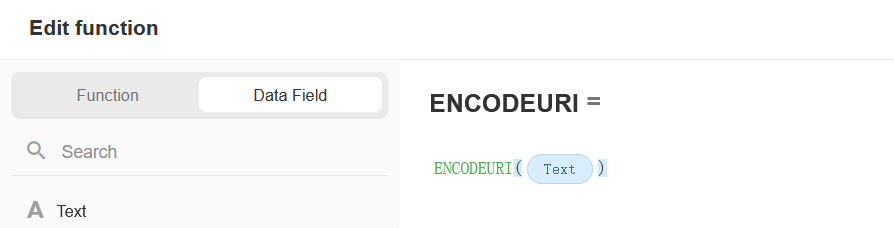
*Result

Herr %20 represents a space in URL encoding.
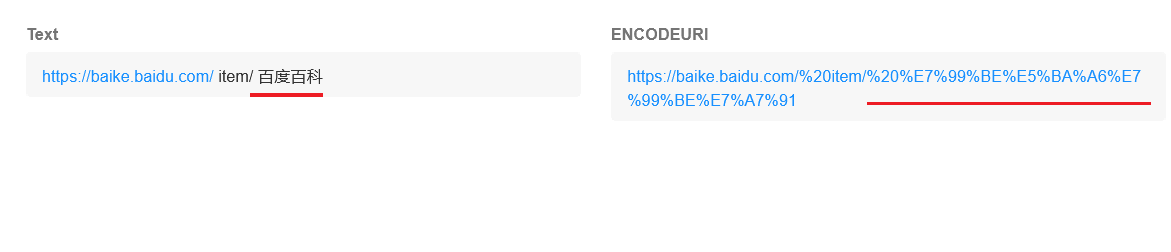
Example 2: Encode non-English characters
If a URL contains non-English characters, they will be encoded into a URI-safe format.
Result
DECODEURI
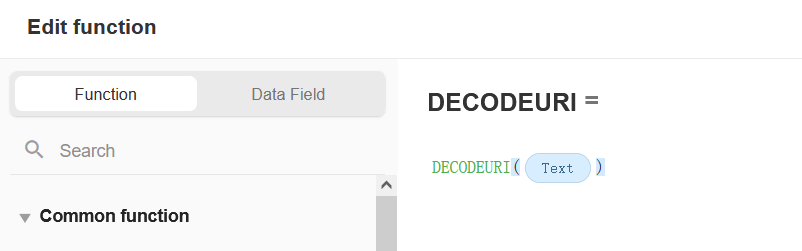
Description:
Decodes a URI-encoded string back into readable text.
Syntax: DECODEURI(text)
Configuration
Result

ENCODEURICOMPONENT
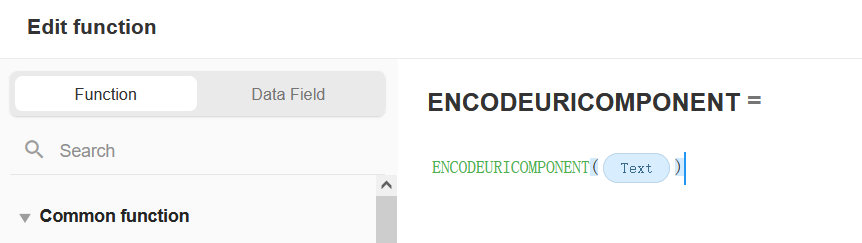
Description:
Encodes a text string as a URI component.
Compared to ENCODEURI, this function encodes more reserved characters and is typically used for encoding query parameters.
Characters such as ; / ? : @ & = + $ , # will be encoded into hexadecimal escape sequences.
Syntax: ENCODEURICOMPONENT(text)
Configuration
Result

DECODEURICOMPONENT
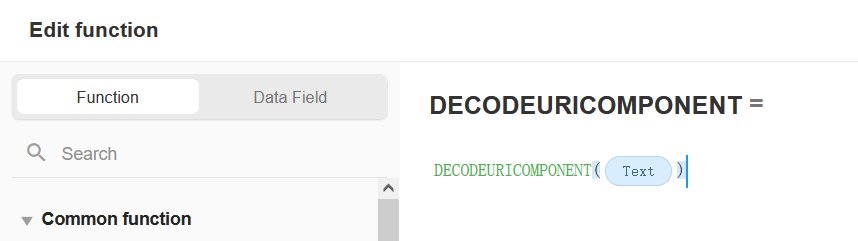
Description:
Decodes a URI component encoded by ENCODEURICOMPONENT.
Syntax: DECODEURICOMPONENT(text)
Configuration
Result

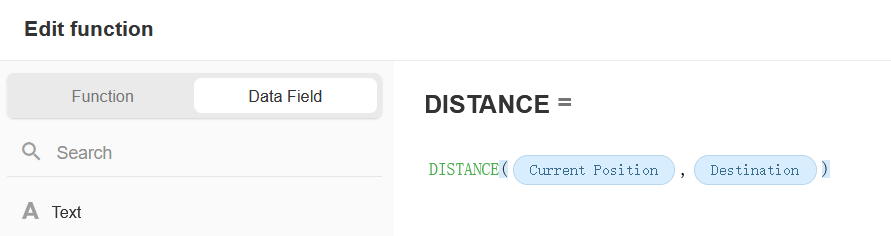
DISTANCE
Description:
Calculates the distance between two location fields.
The result is returned in kilometers (km). To convert to meters, multiply the result by 1000.
Syntax: DISTANCE(location1, location2)
Example: Calculate distance between two locations
Configuration
Result

Using a fixed location
If one of the locations is fixed (for example, an office location), you can directly enter coordinates:
DISTANCE(LocationField, "longitude,latitude")
Example: DISTANCE(Check-in Location, "121.4737,31.2304")
How to get coordinates
Enable Show Latitude and Longitude in the location field settings.
After selecting a location in a record, the coordinates will be displayed.

GETPOSITION
Description:
Retrieves specific details from a location field, such as title, address, or coordinates.
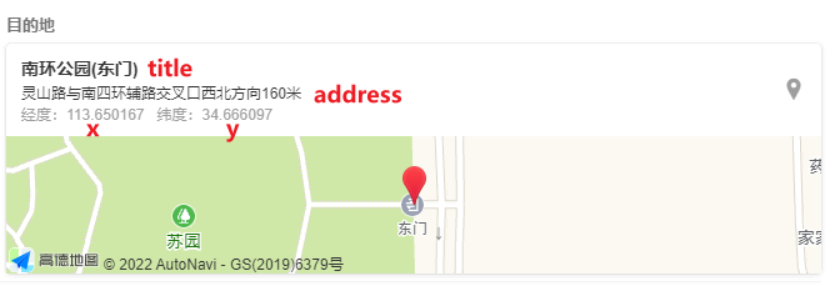
Syntax: GETPOSITION(location, 'property')
Supported properties:
| Property | Code |
|---|---|
| Location name/title | 'title' |
| Full address | 'address' |
| Longitude | 'x' |
| Latitude | 'y' |
| Longitude and latitude | 'x,y' |
Notes:
- The property code must be enclosed in single quotes and written in lowercase.
- Not all locations include a title value.
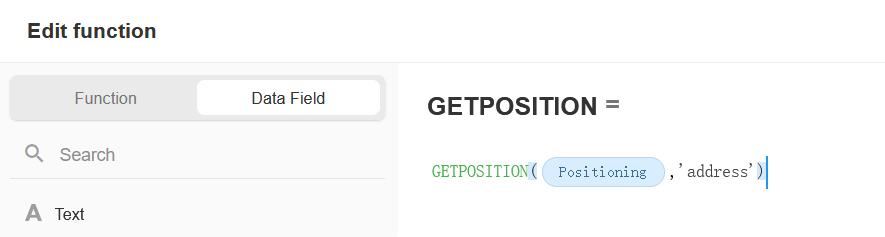
Example: Get full address
Configuration
Result

Was this document helpful?